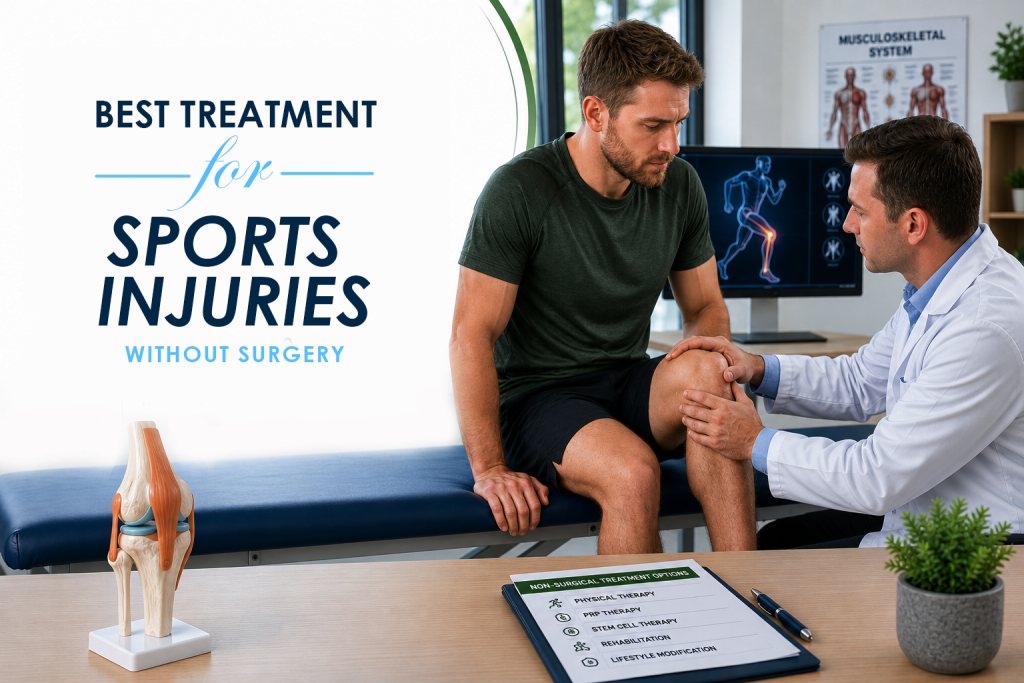
Avoid Surgery: Best Treatment for Sports Injuries Without Surgery

Avoid Surgery: Best Treatment for Sports Injuries Without Surgery

For many athletes across the UK and Ireland, a sports‑related injury can feel like a life‑altering setback, especially when the word “surgery” is mentioned. Yet, advances in sports injury treatment UK and sports injury treatment Ireland now offer powerful non‑surgical options including platelet‑rich plasma (PRP) and mesenchymal (stem) cell‑based therapies. They can help players avoid the knife, reduce downtime, and return to sport with less hardware and shorter rehab.

Common injuries treated without surgery

Regenerative approaches are used for a wide spectrum of soft‑tissue and joint problems. Typical examples include:

Many of these respond poorly to simple rest and painkillers, but they often do not require full reconstruction. Instead, targeted injections and tailored rehabilitation are increasingly used in modern best best sports injury clinic  Ireland and sports injury treatment near me pathways.

Why athletes choose regenerative medicine

Athletes, from weekend warriors to professionals, are drawn to regenerative treatments for several practical reasons:

Techniques such as PRP (platelet‑rich plasma) and mesenchymal cell therapy harness the body’s own healing factors and stem‑like cells to reduce inflammation, support tissue repair, and potentially avoid long‑term disability.

In real‑world practice, many patients report noticeable improvement within a few days, mainly from the anti‑inflammatory punch of growth factors, followed by slower but gradual structural healing over weeks and months.

Recovery time vs physiotherapy vs surgery

Choosing the right option means weighing risks, recovery duration, and performance goals.

For many athletes, combining regenerative injections with structured physiotherapy now offers a middle ground: a gentler start than surgery, but with a stronger biological “kick” than standard rehab alone.

PRP for ligament injuries

PRP is a centrifuged sample of the patient’s own blood, concentrated to deliver a high dose of platelets and growth factors to the injured site. For ligaments such as the ACL or MCL, PRP can:

A recent Pubmed‑indexed study on acute ACL injuries treated conservatively with PRP found that, in patients who opted for non‑surgical management, all individuals regained ligament continuity and returned to sport, with only one re‑rupture reported. This suggests that selected cases of ACL injury—especially partial tears or those in lower‑risk sports—may be suitable for PRP‑supported rehabilitation rather than immediate reconstruction, at least within defined protocols.

In the context of sports injury treatment Ireland and sports injury treatment UK, PRP is increasingly positioned as an adjunct to structured rehab rather than a standalone “magic shot,” helping to shorten the painful early phase and potentially reduce the frequency or scale of surgery.

Return to sport timelines

For any athlete, the million‑dollar question is: When can I play again?

The key is individualisation: an older amateur may return to light running or cycling sooner, while a professional in a high‑impact sport may follow a stricter, longer‑duration protocol supervised by both a sports‑med specialist and physiotherapist.

Frequently Asked Questions:

For many soft‑tissue and joint injuries, the best sports injury treatment Ireland and PRP treatment for sports injury treatment UK strategy now combines early expert diagnosis, targeted injection‑based therapy (such as PRP or regenerative cell‑based treatments), and a bespoke physiotherapy programme. This procedure supports the body’s natural repair process in order to get rid of pain. By doing so, it helps athletes avoid going under the knife.

Yes, some ligament injuries—particularly partial tears, chronic mild instability, or cases in lower‑impact sports—can heal or function well without surgery, especially when supported by PRP, prolotherapy, and intensive rehabilitation. However, each case must be carefully assessed; complete tears in highly demanding athletes may still require surgical reconstruction.

Many patients experience reduced pain and inflammation within a few days of a PRP injection, thanks to the anti‑inflammatory growth factors. However, real, long‑lasting healing in the tissue usually takes several weeks to a few months. It’s not an instant fix—many people need one or more follow‑up injections alongside a steady, well‑structured rehabilitation programme for the best results.

In modern, regulated sports injury treatment Northern ireland and sports injury treatment Belfast settings, mesenchymal or adipose‑derived cell therapies are generally considered low‑risk when performed as minimally invasive, same‑day procedures with strict sterility. Side‑effects are usually mild (post‑injection soreness, bruising), and because the cells are the patient’s own, there is no risk of rejection. As with any medical treatment, long‑term safety data are still evolving, so patients should seek clinics that follow evidence‑based protocols and transparent consent processes.

Conclusion

Across the UK and Ireland, athletes are increasingly turning to non‑surgical, regenerative strategies such as PRP and cell‑based injections as realistic alternatives to traditional surgery, especially for ligament, tendon, and cartilage problems. When combined with expert diagnosis and tailored rehab, these options can shorten recovery, preserve natural anatomy, and support a smoother return‑to‑sport journey.

Share:

Send Us A Message
RECENT ARTICLES

Previous

Next