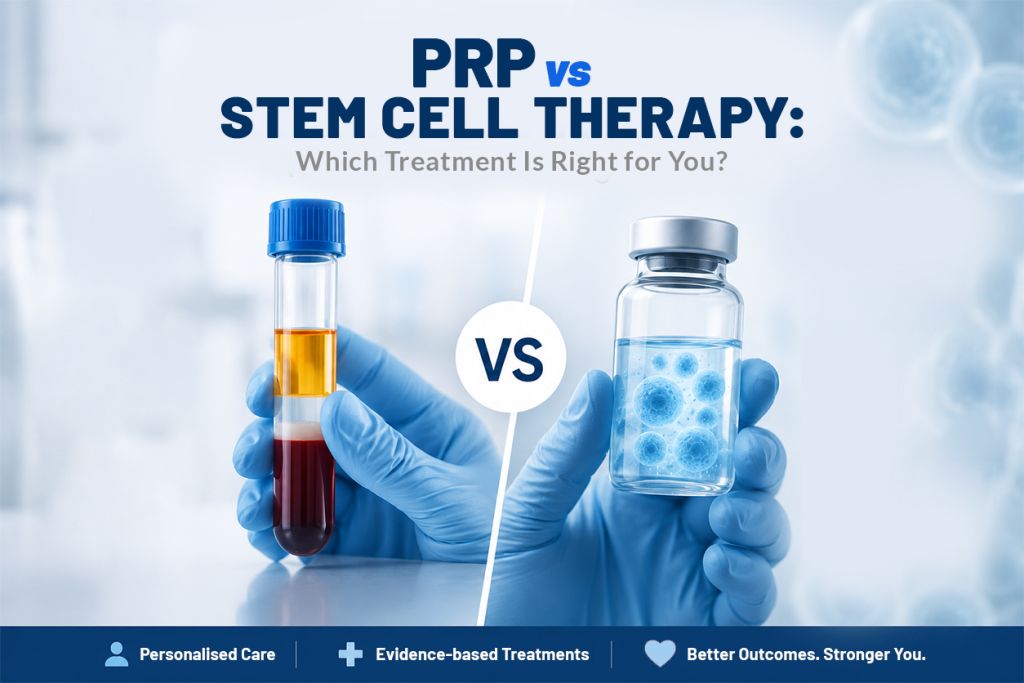
PRP vs Stem Cell Therapy: Which Treatment Is Right for You?

PRP vs Stem Cell Therapy: Which Treatment Is Right for You?

If you have been looking into options for joint or soft tissue pain, you have almost certainly come across PRP and stem cell therapy. Both come under “regenerative medicine,” but they work differently and they suit different situations. Knowing which therapy makes more sense for every unique condition can save you a lot of time and a fair amount of money.

How PRP vs stem cell therapy works

PRP (Platelet-rich plasma) therapy starts with your own blood. A small sample is drawn, spun in a centrifuge to concentrate the platelets, and injected into the painful area. Those platelets release growth factors that stimulate healing, dial down inflammation, and support whatever cells are already present in the joint or tendon. A 2018 review in the Journal of Oral and Maxillofacial Pathology puts it plainly: PRP’s regenerative potential is real, but it is limited to working with the tissue that is already there.

Stem cell therapy is a different proposition. Mesenchymal stem cells — taken from bone marrow or fat tissue — are unspecialised cells that can divide and, depending on the signals around them, develop into bone, cartilage, or connective tissue. A 2021 review in Pain and Therapy found that MSC-based treatments can reduce pain and improve function in early to mid-stage osteoarthritis and disc-related back pain. The short version: PRP nudges existing tissue to heal better; stem cells can actually build new tissue where it has been lost.

Conditions best treated with PRP

PRP tends to work best when the underlying tissue still has some integrity — when things are damaged but not destroyed. The most common examples are:

Clinics like Medica Stem Cells use PRP regularly for shoulder tendinopathy, knee osteoarthritis, and sports-related soft tissue pain. For most of these cases, PRP is a reasonable first injectable option when the joint still has decent cartilage and the damage has not progressed too far.

Conditions better suited for stem cells

Stem cell therapy comes into its own when degeneration is more advanced or when the goal is genuine tissue regeneration rather than inflammation management:

Because stem cells can differentiate into multiple cell types and exert stronger anti-inflammatory effects than PRP, they are often the better choice when the joint needs rebuilding rather than just settling down.

Treatment success rates & limitations

Neither treatment is a guaranteed fix, and it is worth being clear-eyed about that.

PRP injections for mild to moderate knee osteoarthritis reduce pain and improve function in many patients. That said, effects can wear off over six to twelve months in some cases, and repeat injections may be needed. It carries a very low risk of serious side effects, but it will not turn around advanced arthritis or a large structural tear.

Stem cell therapy has shown more durable improvements across several small to medium trials, with some patients reporting sustained relief for a few years. But outcomes depend heavily on patient selection, how the cells are prepared, and the technique used. Risks include infection, local swelling, and — in theory — concerns about abnormal cell behaviour, though using the patient’s own cells reduces that risk considerably.

Comparing the two directly: stem cells offer broader regenerative potential, but they are more complex, more expensive, and not automatically the better option for very early-stage problems where PRP may do the job perfectly well.

Recovery time comparison

PRP is a straightforward outpatient procedure. Most people manage light activity on the day itself and are back to normal daily tasks within a few days to a week. Heavy loading of the joint is discouraged for several weeks, but the disruption is minimal.

Stem cell extraction and injection are also done as a day case, but the processing involved is more involved than a simple blood draw. Recovery is still much shorter than surgery, though most clinics recommend two to four weeks of reduced impact and a structured rehab programme before returning to running or high-intensity sport.

In short, PRP gets people back faster in the short term. Stem cell therapy asks for a bit more patience upfront, but that structured rehabilitation period is part of getting a good result.

Doctor led recommendation guide

There is no honest way to answer “which is better” without knowing the individual. The decision should factor in several things:

Clinics like Medica Stem Cells work through these factors by combining imaging, clinical examination, and a proper conversation about goals before making any recommendation.

Frequently Asked Questions:

Not as a blanket statement. PRP works well for early-stage tendon and joint problems. Stem cells are generally more appropriate when the degeneration is more significant and tissue regeneration is the actual goal.

Stem cell therapy tends to have more durable effects because it can remodel tissue and reduce inflammation more robustly. PRP relief may last six to twelve months in some patients, and repeat injections are sometimes needed.

Yes. PRP involves a simpler process — blood draw, centrifuge, and injection. Stem cell therapy requires more laboratory work, more specialist time, and that is reflected in the cost.

They can, and some protocols do exactly that. Some clinics use PRP and stem cells together — the thinking being that PRP helps prepare the joint environment, giving the MSCs better conditions to work in. For tendon injuries, osteoarthritis, and stubborn soft tissue problems, combining the two may get better results than either would alone.

Conclusion

Whether you are weighing up options for a knee, shoulder, or hip problem, the best treatment for joint pain ireland is the one that fits your actual situation — the stage of your condition, what you are trying to get back to, and a plan put together by someone who has looked at your imaging and examined you properly. Neither PRP nor stem cell therapy is universally superior. What matters is matching the best treatment for joint pain belfast to the patient, not the other way around.

Share:

Send Us A Message
RECENT ARTICLES

Previous

Next