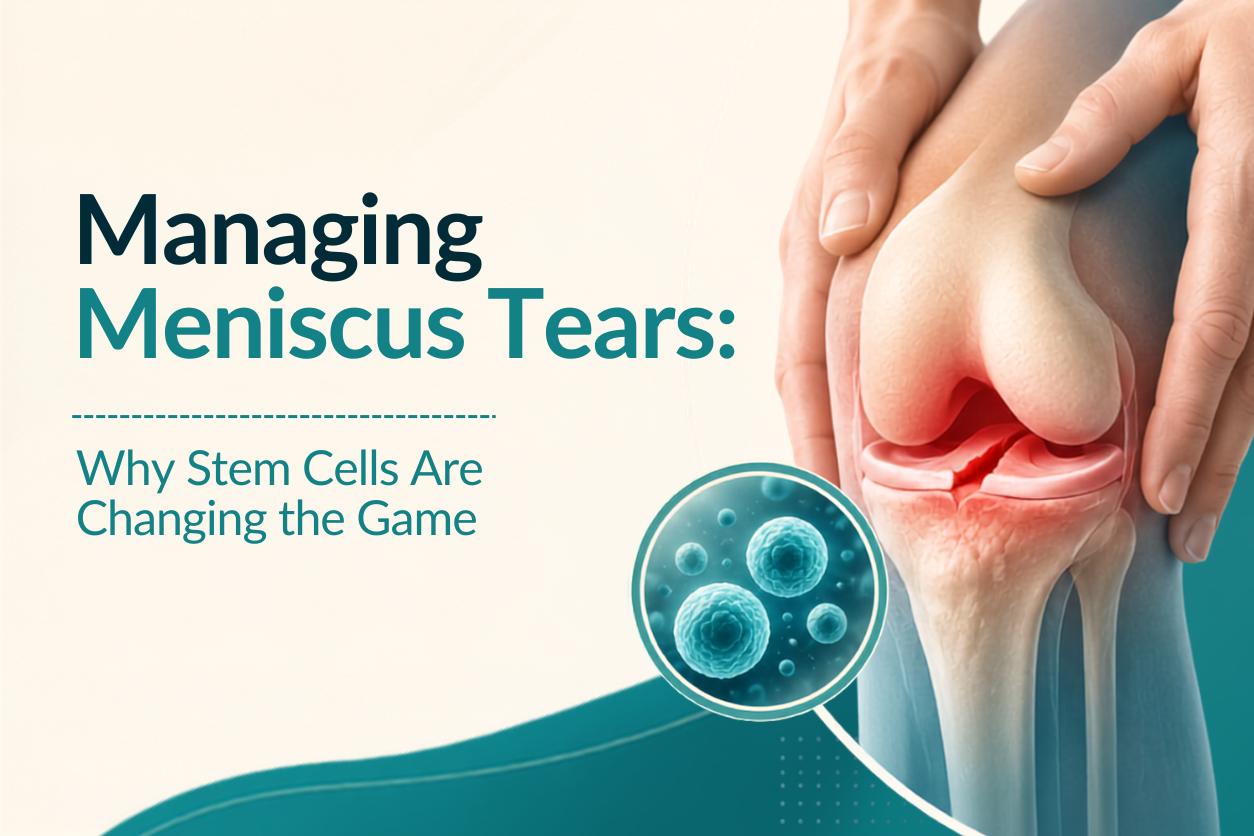
Managing Meniscus Tears: Why Stem Cells Are Changing the Game
A meniscus tear can turn simple movements like climbing stairs or twisting to grab a seatbelt into a source of pain. For many adults in Belfast

Knee pain treatment in Ireland should match the cause of your pain, not just where it hurts. Osteoarthritis, meniscus tears, ligament injuries and tendon problems each need different care. Most people start with exercise, physiotherapy and simple pain relief, adding injections or a surgical opinion when needed.
Perhaps your knee protests on the stairs, stiffens after a long drive, or now decides how far you can walk. Knee pain is one of the most common joint complaints in adults, and it rarely has just one cause. This guide explains why knees hurt, how clinicians reach a diagnosis, and which treatments, costs and clinics to consider in Ireland.
Knee pain can come from the cartilage, menisci, ligaments, tendons, bursae or bone. Osteoarthritis is common in adults over 45. Injuries, overuse and tendon problems explain many other cases, and several causes can overlap.
The knee is a weight-bearing hinge where the thigh bone (femur), shin bone (tibia) and kneecap (patella) meet. Cartilage, two shock-absorbing menisci, four main ligaments and strong tendons share the load. Trouble in any of them can cause pain.
Knee osteoarthritis is a long-term condition in which the cartilage covering the bone ends gradually thins, and the bone and nearby tissues change in response. It typically causes pain with activity, stiffness after rest and reduced movement, although symptoms vary widely between people.
|
Cause
|
What it often feels like
|
Worth getting checked when
|
|---|---|---|
|
Osteoarthritis
|
Gradual ache, stiffness after rest, grinding
|
Pain persists for weeks or limits walking or sleep
|
|
Meniscus tear
|
Joint-line pain, catching, swelling after a twist
|
The knee locks or keeps swelling
|
|
Ligament injury
|
Sudden pop, rapid swelling, giving way
|
Any injury followed by swelling or instability
|
|
Tendinopathy
|
Pain above or below the kneecap with jumping or stairs
|
Pain continues despite reducing load
|
|
Bursitis
|
Localised swelling, often after kneeling
|
Swelling is hot, red or growing
|
|
Patellofemoral pain
|
Ache around the kneecap, worse after sitting
|
Symptoms return whenever activity increases
|
|
Inflammatory arthritis or gout
|
Warmth, swelling, long morning stiffness
|
Promptly, especially if other joints are affected
|
An old sports injury can also change how the knee loads, contributing to arthritis years later. Less commonly, pain comes from infection or is referred from the hip or lower back. Our pages on knee arthritis and osteoarthritis and meniscus tear treatment explore two frequent causes in depth.
Pain, swelling, stiffness and reduced movement are the most common symptoms, along with clicking, weakness or giving way. Book an assessment if pain lasts beyond a few weeks, keeps returning, follows an injury or limits daily life.
The pattern of symptoms often hints at the cause. Pain coming down stairs tends to point to the kneecap joint. Locking suggests a mechanical problem such as a torn meniscus. Long morning stiffness with swelling in several joints may suggest inflammatory arthritis. Painless clicking on its own is common and usually harmless.
Seek same-day help from your GP, an out-of-hours service, an Injury Unit or an Emergency Department (in Northern Ireland, your GP, GP out-of-hours or ED) if:
Diagnosis starts with a detailed history and a hands-on examination. Imaging is added when it will change decisions, not by default. Treatment works best when it targets the cause rather than the pain alone.
A clinician will ask when the pain began, what eases or aggravates it and what you have tried. They check swelling, alignment and range of motion, test the ligaments and menisci, and watch how the knee copes as you walk or squat.
X-rays show joint space narrowing and alignment when arthritis is suspected. MRI shows the menisci, ligaments and cartilage, while ultrasound suits tendons and bursae. Blood tests help if infection, gout or inflammatory arthritis is possible.
Scans need careful interpretation. NICE guidance (NG226, 2022) states that osteoarthritis can usually be diagnosed clinically, without imaging, in people aged 45 or over with activity-related pain and morning stiffness lasting no more than 30 minutes. Many people without pain also show age-related changes on scans.
Options range from exercise and physiotherapy through medicines and injections to regenerative treatment and surgery. The right combination depends on your diagnosis, its severity and what you want to get back to doing.
Most people reach knee care through their GP and the HSE, through private physiotherapy, or by booking directly with a private clinic. Whichever route you take, treatment usually follows a stepped approach.
NICE places education, therapeutic exercise and, where relevant, weight management at the core of osteoarthritis care. Strengthening the thigh and hip muscles improves function across many knee conditions. Medica includes physiotherapy within its knee care.
Topical anti-inflammatory gels are usually tried first for knee osteoarthritis, with oral versions for short courses after weighing stomach, kidney and heart risks. Corticosteroid injections can ease pain for a few weeks, particularly to support exercise. Some clinics offer hyaluronic acid injections, but NICE does not recommend them for osteoarthritis.
Platelet-rich plasma (PRP) is a concentrate prepared from a small sample of your own blood. A centrifuge concentrates the platelets, which carry growth factors and signalling proteins. The concentrate is then injected into the painful area to influence inflammation and the local healing environment.
The evidence for PRP in knee osteoarthritis is mixed. Some trials report better pain and function scores. However, the RESTORE randomised trial (Bennell et al., JAMA, 2021) found no significant difference between PRP and saline injections at 12 months.
Evidence for cell-based treatments, such as bone marrow aspirate concentrate (BMAC), is still developing. Medica’s clinicians have published a systematic review on BMAC and adipose-derived cells for knee osteoarthritis. These treatments are not a cure and do not suit everyone. Read more about PRP therapy and non-surgical regenerative therapy.
Surgery remains the right answer for some knees. Options include arthroscopy for specific mechanical problems, ligament reconstruction, realignment surgery (osteotomy) and partial or total knee replacement for advanced arthritis.
Often, yes. Most people with osteoarthritis, patellofemoral pain, tendon problems or degenerative meniscus tears start with non-surgical care. Surgery is usually reserved for clear structural damage, or for symptoms that stay severe despite a full course of non-surgical treatment.
Non-surgical care cannot reverse advanced joint damage. It may also be unsuitable for a knee that locks, gives way repeatedly or is badly deformed. Medica’s knee surgery alternative page outlines the non-surgical options it offers.
Only a clinical assessment can answer this. Clinicians weigh several factors together:
People with mild to moderate osteoarthritis whose symptoms persist despite exercise may explore joint preservation treatment. A surgical opinion makes more sense when pain is severe, disturbs sleep or continues despite a full course of non-surgical care. A good clinic will tell you if that applies to you.
There is no single price. Costs depend on the consultation, any imaging, the treatment type, the number of sessions and follow-up. HSE care follows a GP referral, while private clinics set their own fees.
Ask for an itemised written quote, and check whether imaging or extra sessions cost more. Medica tailors plans to each patient, so please contact Medica for current fees. Insurance cover varies between policies, and some unreimbursed medical expenses may qualify for health expenses tax relief from Revenue.
Choose a clinic where registered clinicians examine you before recommending anything, explain the evidence and its limits, and price transparently. Be wary of any clinic that guarantees results.
You can meet the clinicians on the Our Team page.
Medica Stem Cells offers non-surgical treatment for selected knee conditions in Dublin, Cork, Mullingar and Belfast. A doctor assesses every patient before recommending treatment, and you do not need a GP referral.
Options may include physiotherapy-led rehabilitation, PRP and other same-day orthobiologic treatments using your own cells, performed under local anaesthetic.
Osteoarthritis, overuse, tendon problems, bursitis and weak thigh or hip muscles are common culprits. Inflammatory arthritis and gout are less frequent. Our article on the hidden causes of recurring knee pain explores these further.
Many people manage early and moderate arthritis without a replacement, using exercise, weight management, pain relief and injections. Replacement is usually considered when advanced arthritis seriously affects quality of life despite other treatment.
Pain from a minor strain or brief overuse often settles within days to weeks. Pain that lasts longer, keeps returning or worsens should be assessed.
Physiotherapy for arthritis or tendon problems often runs from several weeks to a few months. Injection treatments involve follow-up reviews over the following months.
If rest, tablets and exercises have made little difference, an assessment can clarify the likely cause and which options may suit you, including ones Medica does not provide. Book a consultation with our clinical team, or take the free online Joint Health Assessment, which takes two to three minutes. You can also call the Dublin clinic on +353 (0)1 298 8000.
This article is for informational purposes only and does not constitute medical advice. Individual results may vary. Please consult a qualified clinician before making any treatment decisions.
A meniscus tear can turn simple movements like climbing stairs or twisting to grab a seatbelt into a source of pain. For many adults in Belfast

Rotator cuff injuries are among the most common shoulder problems seen in athletes, particularly those in overhead and throwing sports such as…

If your joints have ached for months, it is tempting to hope the problem will simply settle on its own. That hope often quietly turns into years of working…

Joint pain does not wait for a convenient time. It can make stairs feel steeper, gardening feel impossible, and a good night’s sleep harder to come by…

Tell us about your condition and our team will be in touch.
Thank you {{_full_name}}!
We will be in contact with you shortly.