
A meniscus tear can turn simple movements like climbing stairs or twisting to grab a seatbelt into a source of...

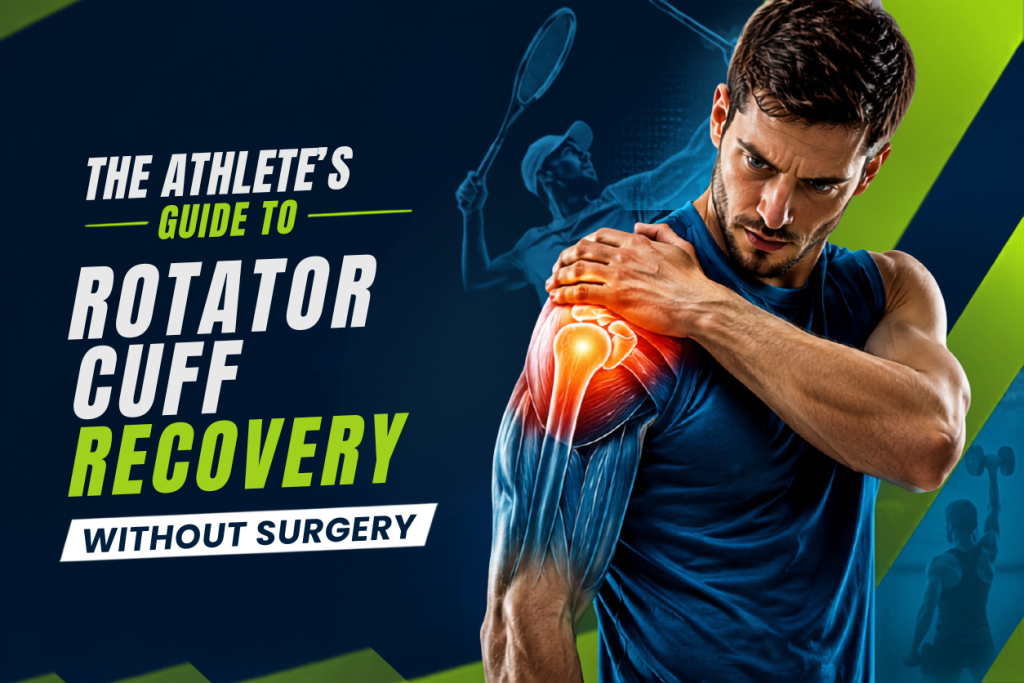
Rotator cuff injuries are among the most common shoulder problems seen in athletes, particularly those in overhead and throwing sports such as swimming, tennis, cricket and rugby. Repetitive overhead movement places sustained load on the rotator cuff tendons, and this cumulative strain is a major contributor to injury. For many athletes searching for rotator cuff recovery without surgery, early assessment and the right non-surgical plan can make a meaningful difference to how the shoulder responds over the following months.
Not every rotator cuff tear needs an operation. Partial tears and tendinopathy often respond to a structured, non-surgical approach when they are identified and managed early. This guide explains the anatomy of the injury, when surgery is genuinely necessary, and what current evidence says about non-surgical options including physiotherapy, PRP therapy and stem cell therapy.
Many partial-thickness rotator cuff tears and cases of tendinopathy can improve with non-surgical treatment, including physiotherapy, activity modification and, in selected patients, PRP or stem cell injections. Full-thickness tears, ongoing weakness or a lack of progress after a genuine trial of conservative care usually warrant a specialist surgical opinion.
The rotator cuff is a group of four muscles and their tendons that surround the shoulder joint. It holds the top of the arm bone in the shoulder socket and controls rotation and lifting movements of the arm.
The four muscles, supraspinatus, infraspinatus, teres minor and subscapularis, work together to stabilise the shoulder during almost every upper body movement. The supraspinatus tendon is injured most often, largely because it passes through a narrow space beneath the acromion bone, where it can become compressed or irritated during repeated overhead motion.
A partial-thickness tear damages some, but not all, of the tendon fibres, leaving the tendon still structurally intact. A full-thickness tear extends completely through the tendon, sometimes separating it from the bone entirely. This distinction matters because it strongly influences whether non-surgical rotator cuff treatment is appropriate.
Surgery is sometimes the right course of action, but it comes with real costs that matter to a competing athlete. Understanding these trade-offs helps explain why so many athletes actively search for rotator cuff recovery without surgery before considering an operation.
Surgery still has an important place in shoulder care. It is generally recommended for full-thickness tears causing significant weakness, tears that fail to improve after a genuine period of conservative treatment, or tears in younger, high-demand athletes where tendon healing potential and function are a priority.
The honest answer depends on the type and severity of the injury. Tendon tissue has a limited capacity to repair itself, and outcomes vary between patients, which is why a professional assessment matters before choosing a treatment path.
Tendinopathy describes a painful, irritated tendon without a structural tear. It results from repetitive overload that outpaces the tendon’s ability to repair itself, leading to localised inflammation and, over time, changes in the tendon’s internal structure.
Partial tears and tendinopathy are the two presentations most likely to respond to conservative management. Inflammation in the early stages often settles with activity modification and targeted rehabilitation. Patient selection, meaning an honest match between the injury type and the treatment chosen, is the single biggest factor in whether non-surgical care succeeds.
A structured non-surgical rotator cuff treatment plan usually combines several of the following approaches, sequenced around the athlete’s symptoms and sporting demands. Many of these methods overlap with our broader approach to sports injury treatment ireland, since the same principles of load management and graded rehabilitation apply across tendon and joint injuries.
Physiotherapy remains the foundation of rotator cuff rehabilitation. A physiotherapist addresses shoulder blade control, posture and movement patterns that may be contributing to tendon overload, alongside a progressive strengthening programme.
Temporarily reducing or adjusting the overhead load, such as altering a swimming stroke or throwing technique, allows irritated tendon tissue time to settle without requiring complete rest from sport.
Short-term pain relief, guided by a clinician, can help an athlete engage properly with rehabilitation exercises rather than avoiding movement altogether.
Progressive resistance exercises targeting the rotator cuff and shoulder blade muscles build the tendon’s capacity to tolerate load, which is central to long-term recovery.
PRP therapy, or platelet-rich plasma therapy, involves drawing a small sample of the patient’s own blood, concentrating the platelets, and injecting this concentrate into the injured tendon. Platelets release growth factors that are involved in the body’s natural tissue repair process.
A double-blind randomised controlled trial published in Arthroscopy in 2021 compared PRP therapy belfast with corticosteroid injection in patients with partial-thickness rotator cuff tears and tendinopathy. Patients who received PRP showed greater improvement in pain and function at 3 months, although this advantage was not sustained at 12 months compared with corticosteroid.
Not all evidence points the same way. A systematic review and meta-analysis of five randomised controlled trials found that PRP injection and control treatment produced similar results for pain and function in rotator cuff tendinopathy at 3 to 12 weeks. This mixed evidence base is why PRP therapy for rotator cuff injuries is offered as one option among several, not a guaranteed solution.
Stem cell therapy, in this context, most often uses mesenchymal stem cells drawn from the patient’s own bone marrow or fat tissue. These cells are injected into the injured area, where they may support tissue repair and reduce local inflammation.
An observational cohort study following 30 patients with partial-thickness rotator cuff tears treated with culture-expanded mesenchymal stem cell injections reported significant improvements in pain and function scores between 3 months and 2 years of follow-up. As the study had no control group, these results should be interpreted as encouraging rather than conclusive.
A separate randomised, controlled first-in-human pilot study compared adipose-derived regenerative cells with corticosteroid injection for symptomatic partial-thickness tears, reporting that the cell-based treatment was safe and more effective than corticosteroid at long-term follow-up. Regenerative treatment for shoulder injuries continues to be an active area of clinical research, and results differ across cell types, preparation methods and injury severity.
Whether the injection is PRP or a stem cell preparation, ultrasound guidance allows the clinician to place the injection precisely within the affected tendon or joint space, which improves accuracy compared with a landmark-guided injection.
Orthobiologic therapies work through biological mechanisms distinct from standard anti-inflammatory treatment.
A systematic review of mesenchymal stem cell injections used alongside rotator cuff repair surgery, covering 228 patients across five studies, found a protective effect against re-tear in the mid-term and long-term follow-up periods, with relative risk reductions reported at both stages. This evidence relates to stem cells used as a surgical adjunct, which is a different clinical scenario from non-surgical injection alone, and the distinction matters when discussing appropriate candidates.
In our clinic, patients with partial-thickness supraspinatus tears who complete a full assessment and structured rehabilitation programme alongside regenerative injection therapy are followed up at regular intervals to track pain scores and functional range of motion. Not every patient responds the same way, and outcomes are documented individually rather than assumed.
Appropriate candidates for regenerative treatment typically have a confirmed partial tear or tendinopathy, have tried a genuine period of physiotherapy, and do not have a large full-thickness tear or significant structural instability. Current evidence and limitations mean that regenerative therapies should be presented as a considered option, not a certainty, and every patient should discuss individual suitability with a qualified clinician.
Recovery from a rotator cuff injury generally moves through recognisable phases, although exact timeframes vary between individuals and sports.
Rotator cuff recovery time varies widely depending on tear severity, sport demands and how consistently rehabilitation is followed. Injury prevention work, including ongoing shoulder blade control and load management, is usually continued well beyond the point symptoms resolve.
Non-surgical rotator cuff treatment tends to suit specific presentations rather than every type of shoulder injury.
Surgery should be considered when there is a full-thickness tear with significant weakness, when symptoms fail to improve despite a genuine trial of conservative treatment, or when imaging shows a tear pattern unlikely to respond to non-surgical care. A qualified clinician can assess which category applies to an individual patient.
Our clinical team focuses specifically on regenerative orthopaedics, including PRP therapy and stem cell therapy for tendon and joint injuries. Every patient receives a comprehensive assessment, including a review of imaging and prior treatment history, before any recommendation is made.
Some partial-thickness tears and cases of tendinopathy improve with non-surgical treatment. Full-thickness tears are less likely to heal without surgical repair, and suitability depends on individual assessment.
Recovery time varies with tear severity and treatment approach. Non-surgical rehabilitation often spans several weeks to a few months, while recovery following surgery typically takes 4 to 6 months or longer.
Evidence is mixed. Some trials show short-term benefit over corticosteroid injection, while a meta-analysis found no clear advantage over control treatment at 3 to 12 weeks. Response varies between patients.
Stem cell therapy may support the tendon's healing environment in partial tears, and cohort studies report improvements in pain and function. It is not a guaranteed repair, and a full-thickness tear generally requires a different approach.
Surgery is usually recommended for full-thickness tears with significant weakness, or when symptoms do not improve after a genuine period of conservative treatment.
Many athletes return to sport following a structured rehabilitation programme after regenerative injection therapy, though timelines and outcomes vary by individual and by sport.
Most patients experience brief discomfort during the injection itself, similar to a standard joint injection. Ultrasound guidance helps the clinician place the injection accurately.
This depends on the injury and the individual's response. Some patients are assessed after a single treatment, while others may be reviewed for a second injection based on follow-up findings.
Overhead lifting and heavy pressing movements are usually avoided in the early stages of recovery, and any exercise that reproduces sharp pain should be reported to your physiotherapist.
A clinical assessment, usually including a review of imaging such as ultrasound or MRI, is needed to determine whether your specific tear or tendinopathy is suited to non-surgical treatment.
Rotator cuff recovery without surgery is a realistic path for many athletes with partial tears or tendinopathy, particularly when treatment begins early and follows a structured rehabilitation programme. Regenerative options such as PRP therapy and stem cell therapy add further tools to that plan for carefully selected patients, though evidence for both remains an active area of research rather than a settled guarantee.
Every shoulder injury is different, and the right treatment path depends on tear type, severity and individual response to prior treatment. Book a professional assessment with our clinical team to discuss whether non-surgical treatment is an appropriate option for your shoulder.
A meniscus tear can turn simple movements like climbing stairs or twisting to grab a seatbelt into a source of...

Rotator cuff injuries are among the most common shoulder problems seen in athletes, particularly those in overhead and throwing sports...

If your joints have ached for months, it is tempting to hope the problem will simply settle on its own....

Joint pain does not wait for a convenient time. It can make stairs feel steeper, gardening feel impossible, and a...



Thank you {{_full_name}}!
We will be in contact with you shortly.